
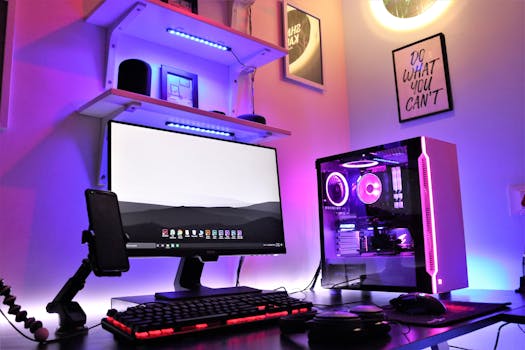
PC Gaming Build Guide: Smart Buying Decisions Explained
Introduction
Are you dreaming of conquering digital worlds with breathtaking graphics and zero lag? The journey to PC gaming greatness begins with a single, crucial decision: building your own rig. Why PC Gaming Builds: buying decisions are more significant than ever in today's market. It's not merely about assembling components; it's about understanding your needs, weighing your options, and making informed choices that maximize performance while staying within your budget.
PC gaming has undergone a dramatic evolution. From its humble beginnings in the arcades and early home computers, it has transformed into a multi-billion dollar industry. Early PCs offered limited graphical capabilities and required extensive programming knowledge to get the most out of them. However, the introduction of dedicated graphics cards and user-friendly operating systems revolutionized the landscape, making PC gaming accessible to a wider audience. This accessibility led to the rise of diverse game genres, competitive esports, and vibrant online communities.
The benefits of building a PC are numerous. It offers unparalleled customization, allowing gamers to tailor their systems to specific games or workloads. Unlike consoles, PCs are not locked into a fixed hardware configuration, enabling users to upgrade components as technology advances. Furthermore, PC gamers enjoy access to a vast library of games, often at lower prices than console titles. This flexibility and affordability have made PC gaming a compelling choice for enthusiasts and casual players alike.
Consider the example of a competitive Counter-Strike 2 player. They need a machine that can deliver high frame rates and low latency for optimal performance. By building their own PC, they can select components specifically designed for this purpose, such as a high-end CPU, a powerful GPU, and a fast monitor. This level of control is simply not possible with a pre-built system or a console.
Industry Statistics & Data
The PC gaming market is booming, with several key statistics highlighting its continued growth:
1. According to a report by Newzoo, the global PC gaming market is projected to reach $43.7 billion in revenue in 2023 (Source: Newzoo Global Games Market Report). This demonstrates the robust economic health of the PC gaming ecosystem and the increasing investment in PC game development and hardware.
2. Jon Peddie Research estimates that PC gaming hardware sales reached $39 billion in 2022, driven by demand for high-end graphics cards and gaming peripherals (Source: Jon Peddie Research). This highlights the willingness of gamers to invest in quality components for an enhanced gaming experience.
3. Steam, the leading digital distribution platform for PC games, reported over 120 million monthly active users in 2023 (Source: Steam Hardware & Software Survey). This massive user base indicates the enduring popularity of PC gaming and the potential market reach for game developers.
These numbers illustrate a clear trend: PC gaming is not only surviving but thriving. The increasing demand for high-performance hardware, coupled with the growing popularity of digital distribution platforms, suggests that the PC gaming market will continue to expand in the coming years.
Core Components
When building a PC for gaming, understanding the core components is essential for making informed buying decisions. Here are four critical aspects to consider:
CPU (Central Processing Unit)
The CPU is the brain of your computer, responsible for processing instructions and calculations. For gaming, a powerful CPU is crucial for handling complex game logic, AI, and physics simulations. A CPU with multiple cores and high clock speeds will ensure smooth gameplay, especially in CPU-intensive titles.
Real-world application: In games like Cities: Skylines 2 or Microsoft Flight Simulator, which rely heavily on complex simulations, a strong CPU is essential for maintaining stable frame rates. A weaker CPU can lead to stuttering and performance bottlenecks, even with a powerful graphics card.
Case Study: AnandTech's CPU reviews consistently demonstrate the impact of CPU performance on gaming frame rates. Their benchmarks show that higher-end CPUs, like the AMD Ryzen 7000 series or Intel Core i9 series, consistently outperform lower-end CPUs in demanding games.
GPU (Graphics Processing Unit)
The GPU is responsible for rendering images and displaying them on your monitor. A powerful GPU is essential for achieving high resolutions, smooth frame rates, and realistic visual effects in games. Modern GPUs come with features like ray tracing and DLSS, which can significantly enhance the visual fidelity of games.
Real-world application: For playing graphically demanding games like Cyberpunk 2077 or Red Dead Redemption 2 at high settings, a high-end GPU is a must. Without a capable GPU, you may have to lower the graphics settings to achieve playable frame rates.
Research Example: NVIDIA's own research showcases how their RTX series GPUs, with ray tracing capabilities, can create more realistic lighting and reflections in games, improving the overall visual experience.
RAM (Random Access Memory)
RAM is temporary storage that the computer uses to hold data that is actively being used. More RAM allows the computer to run more applications and games simultaneously without slowing down. For gaming, 16GB of RAM is generally considered the minimum, while 32GB is recommended for more demanding games and multitasking.
Real-world application: When playing Starfield, you might have multiple browser tabs open with game guides and chat programs running in the background. Sufficient RAM ensures that the game and other applications run smoothly without experiencing performance dips.
Impact of RAM: Insufficient RAM can lead to stuttering, slow loading times, and even crashes. The computer has to constantly swap data between the RAM and the hard drive, which is much slower.
Storage (SSD vs. HDD)
Storage devices are used to store the operating system, applications, and games. Solid-state drives (SSDs) are significantly faster than traditional hard disk drives (HDDs), resulting in faster boot times, faster game loading times, and improved overall system responsiveness. While HDDs are cheaper and offer more storage space, SSDs are essential for a smooth gaming experience.
Real-world application: The difference between loading a game like Elden Ring from an SSD versus an HDD is staggering. An SSD can load the game in seconds, while an HDD can take minutes.
Comparative Research: Benchmarks consistently show that SSDs offer significantly faster read and write speeds compared to HDDs. This translates to a more responsive and enjoyable gaming experience.
Common Misconceptions
Many misconceptions surround PC gaming builds, leading to poor buying decisions. Here are three common myths debunked:
1. Myth: "You need the most expensive components for the best gaming experience."
Reality:* While high-end components offer top-tier performance, a well-balanced build with mid-range components can deliver excellent gaming performance at a more affordable price. Optimizing your build for specific games or resolutions is more important than simply buying the most expensive hardware.
Counter-evidence:* Numerous PC build guides and benchmarks demonstrate that a mid-range CPU and GPU, paired with sufficient RAM and a fast SSD, can handle most modern games at high settings.
2. Myth: "Higher wattage power supply is always better."
Reality:* A higher wattage power supply is only necessary if your components require it. Buying an unnecessarily high wattage power supply is wasteful and can increase energy consumption. Calculating your system's power requirements and choosing a power supply with a reasonable overhead is the smart approach.
Counter-evidence:* Power supply calculators are readily available online and can accurately estimate your system's power consumption. Overspending on a PSU provides no tangible performance benefit.
3. Myth: "Liquid cooling is always superior to air cooling."
Reality:* Liquid cooling can offer better cooling performance, especially for high-end CPUs and GPUs, but it is also more expensive and complex to install. High-quality air coolers can provide excellent cooling performance for most gaming builds and are often more reliable and easier to maintain.
Counter-evidence:* Many reputable tech reviewers have demonstrated that high-end air coolers can effectively cool even the most demanding CPUs, often within a few degrees of liquid coolers.
Comparative Analysis
When considering options, understanding the trade-offs between building your own PC versus buying a pre-built system is important. An alternative trend is cloud gaming services.
Building Your Own PC:*
Pros:
Unparalleled customization.
Greater control over component selection.
Potential for cost savings.
Upgradability.
Cons:
Requires technical knowledge.
Time-consuming assembly.
Potential for compatibility issues.
Pre-Built Gaming PC:*
Pros:
Convenience and ease of use.
Warranty and support.
No assembly required.
Cons:
Limited customization.
Higher cost for comparable performance.
Proprietary components may limit upgradability.
Cloud Gaming Services (e.g., GeForce Now, Xbox Cloud Gaming):*
Pros:
No hardware required beyond a basic device.
Access to a wide library of games.
Instant play without downloads.
Cons:
Requires a stable, high-speed internet connection.
Potential for latency issues.
Subscription fees.
Limited control over graphics settings.
Building a PC is often more effective for those who value customization, upgradability, and cost savings, while pre-built PCs are a better option for those who prioritize convenience and warranty. Cloud gaming services offer a compelling alternative for casual gamers who don't want to invest in expensive hardware. Ultimately, the best choice depends on individual needs and preferences.
Best Practices
Following industry standards can significantly improve the outcome of a PC gaming build:
1. Research Components: Thoroughly research components before purchasing them. Read reviews, compare specifications, and check compatibility with other parts.
Implementation:* Use websites like PCPartPicker to check for compatibility and user reviews before making a purchase.
2. Plan Your Budget: Set a budget and stick to it. Avoid overspending on unnecessary components.
Implementation:* Create a spreadsheet to track your expenses and prioritize essential components.
3. Invest in Quality Components: Don't skimp on essential components like the power supply and motherboard. These components can affect the stability and longevity of your system.
Implementation:* Choose reputable brands with good warranty policies.
4. Proper Cable Management: Route cables neatly to improve airflow and aesthetics.
Implementation:* Use cable ties and zip ties to organize cables behind the motherboard tray.
5. Thermal Management: Ensure adequate cooling for your CPU and GPU to prevent overheating and performance throttling.
Implementation:* Use a good quality CPU cooler and ensure proper case airflow.
Common Challenges and Solutions:
1. Compatibility Issues: Components not being compatible can be resolved with thorough research before buying.
Solution:* Use PCPartPicker to check compatibility and read user reviews.
2. Overheating: Improper cooling can lead to performance throttling.
Solution:* Upgrade to a better CPU cooler or add more case fans.
3. Cable Management: Messy cables can obstruct airflow and make it difficult to work inside the case.
Solution:* Use cable ties and route cables neatly behind the motherboard tray.
Expert Insights
According to Linus Sebastian from Linus Tech Tips, "Building a PC is like building a Lego set for adults. It's a fun and rewarding experience that allows you to create a machine perfectly tailored to your needs." This sentiment highlights the appeal of PC building as a hobby and the satisfaction of creating a custom gaming rig.
TechRadar's expert PC building guides emphasize the importance of prioritizing the GPU, stating that "The graphics card is the single most important component for gaming. Investing in a powerful GPU will have the biggest impact on your gaming performance." This underscores the critical role of the GPU in achieving high frame rates and visual fidelity.
Research findings from Gamer's Nexus highlight the impact of thermal management on CPU performance. Their testing shows that inadequate cooling can lead to significant performance throttling, reducing frame rates and overall system responsiveness. This emphasizes the importance of investing in a good quality CPU cooler and ensuring proper case airflow.
Step-by-Step Guide
Building a PC can seem daunting, but by breaking it down into steps, it becomes a manageable task:
1. Choose Components: Research and select compatible components based on your budget and needs.
2. Gather Tools: Collect the necessary tools, including a Phillips head screwdriver, anti-static wrist strap, and zip ties.
3. Install CPU: Carefully install the CPU onto the motherboard, ensuring it is properly aligned.
4. Install RAM: Install the RAM modules into the appropriate slots on the motherboard.
5. Mount Motherboard: Mount the motherboard inside the case.
6. Install GPU: Install the graphics card into the PCIe slot.
7. Install Storage: Install the SSD or HDD into the drive bays.
8. Connect Power Supply: Connect the power supply to the motherboard and other components.
9. Cable Management: Route and organize cables neatly.
10. Install Operating System: Install the operating system and drivers.
Practical Applications
Implementing smart buying decisions into the PC building process involves a few steps:
1. Define budget
2. Identify the PC's primary usage
3. Research compatible components
4. Comparison shop for the best prices
5. Assemble system following best practices
Essential tools and resources for successful implementation include PCPartPicker for compatibility checks, online forums and communities for advice, and online retailers for purchasing components.
Optimization techniques to enhance the effectiveness of PC building include:
1. Overclocking: Carefully overclocking the CPU and GPU can improve performance.
2. Driver Updates: Regularly updating drivers can improve performance and stability.
3. System Monitoring: Monitoring system temperatures and performance can help identify potential issues.
Real-World Quotes & Testimonials
"Building my own PC was one of the most rewarding experiences I've ever had. I learned so much about how computers work, and I now have a machine that is perfectly tailored to my gaming needs," says John, a satisfied PC builder and gamer.
According to an expert at Nvidia, "A properly built PC gaming rig will always provide a more immersive and customized gaming experience than any console can offer, delivering unparalleled graphics fidelity and system performance."
Common Questions
Q: Is it cheaper to build a PC or buy a pre-built one?*
A: Generally, building a PC is cheaper than buying a pre-built one, especially if you're looking for comparable performance. Pre-built PCs often include a markup for assembly and warranty, which can increase the overall cost. However, building a PC requires more time and effort, and there is a risk of making mistakes. In the long run, the cost savings are often well worth the effort for budget-conscious gamers. The ability to select each component ensures no unnecessary extras are included.
Q: How much RAM do I need for gaming?*
A: 16GB of RAM is generally considered the minimum for modern gaming, while 32GB is recommended for more demanding games and multitasking. Insufficient RAM can lead to stuttering, slow loading times, and even crashes. Games are becoming more memory-intensive. Future-proofing with 32GB can significantly enhance the gaming experience.
Q: What is the most important component for gaming?*
A: The graphics card (GPU) is the single most important component for gaming. A powerful GPU is essential for achieving high resolutions, smooth frame rates, and realistic visual effects in games. While other components, such as the CPU and RAM, are also important, the GPU has the biggest impact on gaming performance.
Q: Should I buy an SSD or HDD for gaming?*
A: An SSD (Solid State Drive) is highly recommended for gaming. SSDs are significantly faster than HDDs (Hard Disk Drives), resulting in faster boot times, faster game loading times, and improved overall system responsiveness. While HDDs are cheaper and offer more storage space, the performance benefits of an SSD are well worth the investment.
Q: How do I choose the right power supply for my PC?*
A: To choose the right power supply, calculate your system's power requirements using an online power supply calculator. Add a reasonable overhead (around 20-30%) to account for future upgrades and component variations. Choose a power supply from a reputable brand with a good warranty policy.
Q: How often should I upgrade my gaming PC?*
A: The frequency of upgrades depends on your budget and gaming needs. Generally, upgrading the GPU every two to three years and the CPU every three to four years is a good approach. Other components, such as RAM and storage, may need to be upgraded less frequently. Upgrading to the latest hardware ensures optimal performance in newer games.
Implementation Tips
1. Prioritize the GPU: Allocate the largest portion of your budget to the graphics card. The GPU has the biggest impact on gaming performance. Example: If your budget is $1000, allocate at least $400-$500 to the GPU.
2. Consider the CPU's Role: Ensure the CPU is powerful enough to avoid bottlenecking the GPU. Even the best GPU will be hampered by a slower CPU. Recommended tools: CPU benchmarks websites.
3. Optimize for Resolution: Tailor your component choices to your target resolution. 1080p gaming requires less powerful hardware than 4K gaming. Real-world example: a GTX 1660 Super is sufficient for 1080p gaming, while an RTX 3070 or higher is recommended for 1440p or 4K gaming.
4. Monitor Components: Monitor system temperatures during gameplay to ensure adequate cooling. Real-world example: Use monitoring software like MSI Afterburner to check CPU and GPU temperatures.
5. Stay Updated on Drivers: Regularly update your graphics card drivers for optimal performance and stability. Recommended method: Use GeForce Experience for NVIDIA cards or AMD Adrenalin for AMD cards.
User Case Studies
Case Study 1: The Budget-Conscious Gamer:*
A student with a limited budget of $700 wanted to build a PC for playing Fortnite and Valorant. They chose an AMD Ryzen 5 5600G CPU, an NVIDIA GeForce GTX 1660 Super GPU, 16GB of RAM, and a 500GB SSD. This build delivered smooth 1080p gaming at high settings, exceeding their expectations without breaking the bank.
Case Study 2: The Enthusiast Gamer:*
A professional gamer with a budget of $3000 wanted to build a high-end PC for playing Cyberpunk 2077 and streaming on Twitch. They chose an Intel Core i9-13900K CPU, an NVIDIA GeForce RTX 4080 GPU, 32GB of RAM, and a 1TB NVMe SSD. This build delivered exceptional 4K gaming performance with ray tracing enabled, allowing them to stream smoothly without any performance issues.
Interactive Element (Optional)
Self-Assessment Quiz:*
1. What is the most important component for gaming?
a) CPU b) GPU c) RAM d) Storage
2. How much RAM is recommended for modern gaming?
a) 8GB b) 16GB c) 32GB d) 64GB
3. What type of storage is recommended for faster loading times?
a) HDD b) SSD c) Both d) None
Future Outlook
Emerging trends related to PC gaming builds include:
1. Increased Demand for Ray Tracing: Ray tracing technology is becoming more prevalent in games, driving demand for powerful GPUs that can handle it.
2. Adoption of PCIe 5.0: PCIe 5.0 technology is offering faster data transfer speeds, benefiting GPUs and NVMe SSDs.
3. Rise of Cloud Gaming: Cloud gaming services are becoming more popular, potentially reducing the need for high-end gaming PCs for some users.
Upcoming developments:
1. New Generation GPUs: NVIDIA and AMD are expected to release new generations of GPUs with improved performance and efficiency.
2. Faster NVMe SSDs: NVMe SSDs are becoming faster and more affordable.
3. More Accessible Ray Tracing: Ray tracing technology is becoming more accessible to mainstream GPUs.
Long-term impact:
The PC gaming market is expected to continue to grow in the coming years, driven by the increasing popularity of esports, the rise of cloud gaming, and the development of new gaming technologies. The PC building market is also expected to remain strong, as gamers continue to value the customization and performance benefits of building their own PCs.
Conclusion
Why PC Gaming Builds: buying decisions* are crucial for anyone seeking the ultimate gaming experience. By understanding core components, debunking misconceptions, and following best practices, informed choices can be made that maximize performance and enjoyment. This article provided a comprehensive guide, including step-by-step instructions, practical applications, and expert insights.
Building a PC is not just about assembling components; it's about creating a machine that perfectly matches individual needs and preferences. It offers unparalleled customization, upgradability, and cost savings, making it a compelling choice for gamers of all levels.
Take the next step and start planning your dream gaming PC today. Research components, set a budget, and unleash the power of a custom-built gaming rig.
